
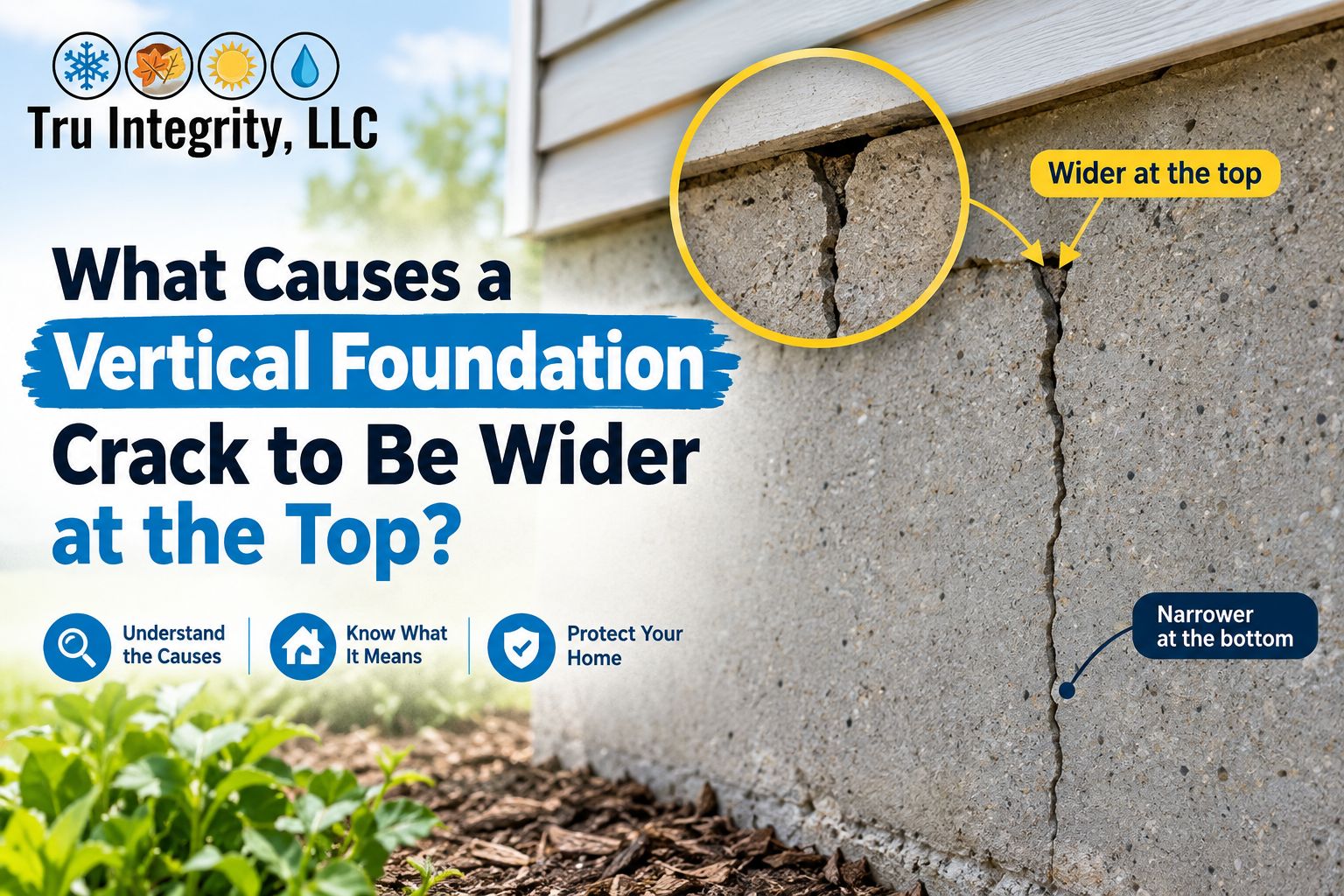
A foundation crack that is wider at the top usually points to uneven movement in the foundation wall or the soil supporting it. Differential settlement, soil movement, wall rotation, and concrete shrinkage can all create this pattern.
The right solution is to identify what is causing the movement before filling or sealing the crack. A repair that only covers the opening may not stop it from returning.
What Does a Crack Wider at the Top Actually Mean?
When a vertical crack in foundation walls is wider at the top than the bottom, the opening is not occurring evenly through the wall. This suggests that different parts of the foundation are responding differently to stress or movement.
The difference may be small, or it may be clearly visible. Either way, the crack pattern is useful because it shows that the concrete has been subjected to some form of uneven force.
A crack like this does not automatically mean the foundation is failing. The age of the crack, its location, and whether it is changing are important when determining what it means.
How Can Differential Settlement Change the Crack Shape?
Differential settlement occurs when different parts of a foundation settle at different rates. One section may sit on stable soil while another settles into softer or poorly compacted ground. This uneven movement can place stress on the concrete and make a crack wider at one end.
Settlement may result from:
- Poorly compacted soil
- Soil moisture changes
- Erosion beneath the foundation
- Different soil conditions
The crack is often a sign of movement rather than the underlying cause.
Can Soil Pressure Push One Part of the Wall Differently?
Soil around a foundation does not always create equal pressure along the wall. Moisture, drainage, soil type, and seasonal changes can affect pressure in different areas.
When pressure is uneven, one section may experience more stress and develop or widen a crack. This differs from horizontal foundation cracks, which are commonly linked to sideways pressure.
The surrounding soil can affect foundation movement even when the concrete appears sound.
Could Concrete Shrinkage Create an Uneven Crack?
Concrete naturally shrinks as it cures and loses moisture. If that shrinkage is restrained, tension can build inside the material.
A crack may form where the stress becomes concentrated. Its width does not have to remain identical from top to bottom.
Shrinkage is particularly worth considering when the crack appeared relatively early in the foundation’s life and has remained stable since then.
This is one reason the history of the crack matters. A long-standing crack that has not changed may have a different cause from a recently developing opening.
Why Can the Crack’s Location Change What It Means?
For example, a crack in the middle of a wall may be caused by settlement, while openings such as windows and doors can create additional stress. The foundation material also matters, as poured concrete and block walls respond differently to movement.
Consider:
- Where the crack starts and ends
- Whether it crosses an opening
- Whether it reaches the floor or ceiling
- Whether nearby cracks are present
- What type of foundation wall you have
These details can make the crack pattern easier to understand.
How Can You Tell if the Crack Is Still Moving?
A crack that is getting wider is more important than one that looks unchanged.
You can document the opening with photographs and record its approximate width at several points. Repeat the measurements over time rather than relying on a single observation.
Also note whether the crack changes after periods of heavy rain, prolonged dry weather, or seasonal temperature changes.
Other changes can provide useful clues:
- The crack becomes longer
- The opening becomes wider
- A previously closed section begins to open
- New cracks appear nearby
- The wall changes position
- Water begins entering through the crack
A vertical crack that continues changing deserves closer attention because ongoing movement may be affecting the foundation.
Why May Sealing the Crack Not Fix the Cause?
Sealing can close a visible opening, but it does not necessarily stop the movement that created it.
If settlement, soil pressure, or wall movement continues, the repaired area can crack again. This is why choosing a repair based only on the appearance of the crack can lead to repeated work.
The repair should match the condition behind the opening. A stable shrinkage crack may require a different approach from one associated with ongoing movement.
Addressing the underlying cause is what makes a repair more useful over the long term.
What Is the Right Way to Repair This Type of Crack?
The correct repair depends on the cause of the crack and whether movement is still happening—not just on how the crack looks.
Step 1
Find the cause
- Examine the crack pattern and other signs of movement (sticking doors, uneven floors, stair‑step cracks).
- Check the foundation wall, soil conditions, and drainage/grading around the house.
- Decide if the movement is active (ongoing) or historic (settled).
Step 2
Choose a matching solution.
- Active/structural issues: May need wall stabilization (anchors, carbon fiber, underpinning) plus crack repair.
- Drainage/soil problems: Regrading, downspout extensions, or exterior drainage work to reduce stress on the foundation.
- Minor, stable cracks: Epoxy/polyurethane injection or sealants once stability is confirmed.
Step 3
Fix the problem, not just the symptom
At Tru Integrity, the priority is identifying why the foundation is cracking, not just covering the visible damage, so repairs are based on the actual condition and behavior of your foundation.
Take Action Based on the Cause
A crack wider at the top should be evaluated based on its cause, not just its appearance. Settlement, soil pressure, wall movement, or concrete shrinkage may be responsible.
Document the crack and watch for changes in width or nearby damage. If you notice a vertical crack in foundation walls that is widening or accompanied by movement, Tru Integrity can help identify the cause and determine the right repair.
Key Takeaways:
- A wider top can indicate uneven movement within or around the foundation.
- Differential settlement can make different sections of a foundation move at different rates.
- Uneven soil pressure can place additional stress on specific areas of a wall.
- Wall rotation can cause a crack to open more at one end.
- Concrete shrinkage can also create cracks with uneven widths.
- The crack’s location and progression provide important context.
- Sealing the opening alone may not resolve the underlying problem.
- The correct repair depends on why the crack developed.
FAQs:
1. What causes a foundation crack to be wider at the top?
Uneven foundation movement is a common reason. Differential settlement, soil movement, wall rotation, and concrete shrinkage can all create a crack that changes in width from bottom to top.
2. Is a foundation crack wider at the top dangerous?
Not automatically. The pattern alone does not determine severity. A changing crack combined with wall movement or other foundation symptoms deserves closer attention.
3. Can foundation settlement make a crack wider at the top?
Yes. When different sections of a foundation settle at different rates, stress can develop in the wall and create an opening that varies in width.
4. Can I simply seal a crack that is wider at the top?
Sealing may close the visible opening, but it may not address the movement causing it. If the crack is active, it can reopen after repair.
5. What should I do if the crack keeps getting wider?
Document the changes and have the foundation evaluated. Finding the cause of the movement is more useful than repeatedly repairing the visible crack.