
Water movement around a property is rarely visible until it begins causing problems. Pooling water, soggy yards, or foundation dampness often signal that surface or subsurface drainage is not functioning as intended.
Did you know that water-related issues around a home are often influenced by grading, soil conditions, and runoff patterns rather than a single visible low spot?
At Tru Integrity LLC, drainage work begins with understanding how water behaves across your property. Instead of offering pre-set systems, drainage recommendations are shaped by on-site conditions, foundation layout, and long-term property protection goals.
Key Takeaways
- Drainage systems manage water movement, not water itself.
- Every property needs a drainage plan based on its layout.
- Proper installation affects lasting performance.
- Costs depend on system type and site conditions.
- Early assessment helps prevent larger water problems.
Objective:
This blog aims to help property owners understand how different drainage solutions work and how to select the right system based on site conditions and lasting protection needs.
What does a drainage system solution actually address?
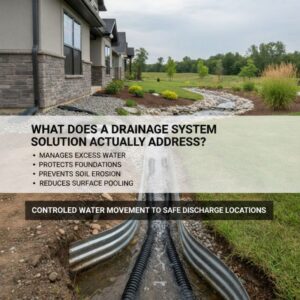
A Drainage system solution is designed to manage excess water by redirecting it away from areas where it can cause damage. This may include protecting foundations, preventing soil erosion, or reducing surface pooling.
Drainage systems generally do not get rid of water completely. Instead, they specifically deal with controlled water movement. This means that water is led to correct discharge locations from where it can be safely spread without impacting structures.
Understanding what problem needs solving is the first step toward selecting the right system.
Why does every property need a different drainage approach?
Water can be managed in an infinite number of ways. For example, the natural slope of the land, soil permeability, existing greenery, and neighboring buildings all have an impact on water that fell as rain and then flowed.
Some homes experience surface pooling, while others face subsurface water pressure near the foundation. This is why selecting the best drainage system solution for residential properties depends on observation rather than assumptions.
Only a thorough assessment will allow you to prevent the installation of such systems that could be not only wasteful but also ineffective due to the presence of specific conditions.
How do drainage systems help protect yards and foundations?
Water that remains close to a foundation for extended periods may increase moisture exposure around walls and footings. Over time, this can contribute to structural concerns or soil instability.
Drainage systems are often selected to support the best drainage solution for yard and foundation protection by moving water away from vulnerable areas. This can help maintain more consistent soil conditions around the home and reduce ongoing water accumulation.
The effectiveness of this protection depends on correct placement and system design.
What types of drainage solutions are commonly considered?
Drainage solutions can include surface systems, subsurface systems, or a combination of both. Surface systems typically address visible pooling, while subsurface options manage water below ground level.
The appropriate choice depends on where water collects and how it moves through the soil. In some cases, multiple components work together to achieve balanced drainage.
At this stage of planning, Tru Integrity LLC emphasizes matching the solution to the problem rather than applying broad fixes, making it the go-to option for basement waterproofing services near me.
What should homeowners know about installation considerations?

Drainage system installation involves more than placing pipes or channels. Proper grading, correct depth, and discharge planning all influence long-term performance.
Installation methods vary depending on soil type, system complexity, and proximity to the foundation. Careful execution helps ensure water flows as intended rather than creating new low points.
This step-by-step approach supports durability and reduces the likelihood of future adjustments.
How does cost factor into drainage decisions?
The cost of installing a drainage system for property can vary based on system type, excavation requirements, and site accessibility. Properties with complex grading or limited access may require additional preparation.
Rather than focusing on a single price range, it is more practical to view cost as part of a broader evaluation that considers long-term effectiveness and property protection.
Clear explanations during the planning phase help homeowners understand how cost relates to scope and system design.
When is combining multiple drainage solutions appropriate?
In some situations, a single drainage system may not address all water concerns. For example, surface pooling and foundation moisture may require different approaches working together.
Combining systems is considered when water behaves differently across the property. This layered approach can help manage both immediate and underlying drainage challenges without overbuilding.
Midway through the evaluation process, Tru Integrity LLC focuses on whether combined solutions add value or unnecessary complexity.
How do you know when professional evaluation is necessary?
Recurring water issues, visible pooling after rain, or damp areas near the foundation are often signs that drainage may need attention. Professional evaluation helps determine whether the issue is related to grading, runoff, or subsurface flow.
Early assessment allows for targeted solutions rather than reactive repairs, supporting more predictable outcomes.
Ready to choose the right drainage system for your property?
Schedule a professional drainage evaluation today
If you are dealing with water pooling, runoff concerns, or foundation-related moisture and want guidance based on real site conditions, Tru Integrity LLC provides drainage assessments tailored to your property.
Effective drainage starts with understanding how water moves across your land.
Frequently Asked Questions
1.Are drainage systems only needed for properties with flooding?
No, drainage systems are often used to prevent future water related issues.
2.Can drainage systems help with foundation moisture?
Yes, directing water away from the foundation can help reduce moisture exposure.
3.Is drainage system installation disruptive to landscaping?
Some disturbance may occur, depending on system type and placement.
4.How long do drainage systems typically last?
Longevity depends on materials, installation quality, and site conditions.
5.Is one drainage system enough for all water issues?
Not always; some properties benefit from multiple coordinated solutions.