
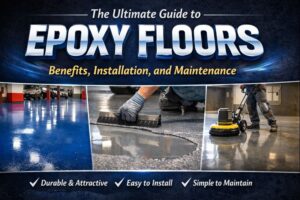
Flooring choices are significant and relevant to the performance of a space in the long term, particularly in garages and basements, where moisture, surface wear, and structural movement are frequent issues. Most residential owners consider Epoxy flooring since it provides an impregnable surface capable of sustaining durability and easy maintenance when put into place under the right conditions.
Did you know that epoxy-based coatings are often selected not just for appearance, but for how they help protect underlying concrete surfaces?
In Tru Integrity LLC, the epoxy solutions are seen as a component of an overall foundation and surface protection program, and not as a cosmetic upgrade.
Key Takeaways
- Epoxy floors protect and seal concrete surfaces.
- Surface preparation determines long-term performance.
- Moisture issues should be addressed first.
- Professional services support better outcomes.
- Proper cleaning helps maintain the finish.
Objective
This blog aims to describe the principles of epoxy flooring, its role in the construction of foundations, and the factors that a homeowner will have to consider prior to installation, maintenance, and usage.
What exactly is epoxy flooring, and where is it typically used?

Epoxy flooring typically incorporates the use of a resin-based coating on prepared concrete. After being cured, it creates a bonded surface capable of assisting in the reduction of dust, surface wear, and minor moisture intrusion.
Epoxy floors are most commonly considered for garages, basements, utility rooms, and areas where the concrete is exposed and is in frequent use. Surface preparation is necessary, and epoxy would attach well to clean and stable concrete.
Why do homeowners prefer using epoxy floors for basements and garages?
The smooth surface and practical nature of epoxy floors are some of the factors that are taken into consideration by homeowners. Epoxy surfaces, when properly installed, can be less difficult to clean and can assist in reducing the amount of contact between moisture on the surface.
Epoxy can also be applied in certain repair works in foundation-related work. As an example, epoxy foundation crack repair is at times prescribed, whereby cracks are non-structural and can be sealed based on inspection results.
How does epoxy floor installation usually work?
Installation is a process in which much emphasis is placed on preparation. The concrete surfaces should be washed, repaired, and evaluated prior to the coating.
A step by step epoxy floor installation guide typically includes surface grinding or cleaning, crack preparation, epoxy application, and curing time. The steps are all needed so that the coating can bond well and work accordingly.
In the middle of numerous flooring talks, Tru Integrity LLC stresses that epoxy floors can be reliable only when the surface under the floors is reliable, and that is why the inspections are important before the start of the installation process.
What is the purpose of the moisture control prior to epoxy application?
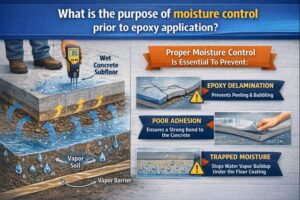
Moisture conditions are an important factor in epoxy. Excess moisture can cause improper bonding and reduce longevity.
That is why epoxy flooring will be frequently discussed alongside basement waterproofing. Active water intrusion/drainage problems can be treated prior to the application of epoxy and thus mitigate the occurrence of subsequent surface failure.
When should professional epoxy services be considered?
While some epoxy kits are marketed for DIY use, professional services are often considered when surface conditions are complex or tied to foundation-related concerns.
An epoxy flooring service can provide evaluation, preparation, and application that aligns with the condition of the concrete and the intended use of the space. Professional involvement may also help ensure compatibility with existing repairs or waterproofing systems.
How should epoxy floors be maintained over time?
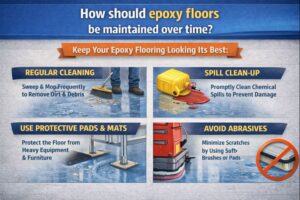
Maintenance for epoxy floors generally involves routine cleaning and avoiding abrasive tools that could damage the surface. Gentle cleaning methods are typically recommended to preserve the finish.
Homeowners often ask about the best cleaners for garage epoxy floors, and neutral, non-abrasive cleaners are commonly suggested to help maintain surface integrity without wearing down the coating.
Are epoxy floors suitable for all foundation conditions?
Epoxy floors are not always the right solution for every basement or garage. If a foundation has ongoing movement, active water intrusion, or unresolved structural concerns, those issues should be addressed first.
Epoxy is best viewed as a surface solution that supports durability after underlying foundation conditions are stabilized.
Talk to a professional about epoxy flooring and foundation protection
If you are considering epoxy flooring as part of your basement or garage improvement plan, Tru Integrity LLC provides inspection-driven guidance to help make sure solutions fit your foundation and moisture conditions. Contact us today to schedule your expert consultation!
Frequently Asked Questions
Q1. Can epoxy flooring be installed over cracked concrete?
Ans. Minor cracks may be repaired first, depending on their condition.
Q2. Does epoxy flooring prevent water from entering a basement?
Ans. It helps seal surfaces but does not replace waterproofing systems.
Q3. How long does epoxy flooring last?
Ans. Longevity depends on preparation, use, and maintenance.
Q4. Is epoxy flooring slippery when wet?
Ans. Slip resistance can vary based on finish and additives.
Q5. Can epoxy floors be repaired if damaged?
Ans. Localized repairs may be possible in some cases