
Water that seeps into the ground around the base of a house can cause damage that is slow and gradual, and sometimes manifests itself in cracked walls, wet spots, or repeated water problems in basements and crawl spaces. Fixing these problems means doing more than just applying temporary solutions; you need to figure out the way water is contacting the building.
Did you know that water does not always enter a foundation from the same direction or source, which is why multiple waterproofing approaches exist?
At Tru Integrity LLC, the foundation waterproofing suggestions are the result of observed conditions, patterns of cracks, and places where water gets in, rather than being based on assumptions. Such a cautious way of working gives the homeowner a chance to know which methods might be their proper ones for the particular problem of their foundation.
What are foundation waterproofing methods, and why do they vary?
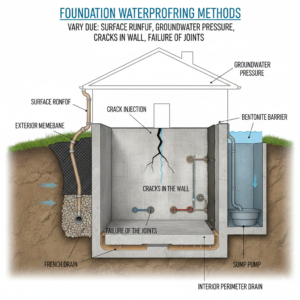
Foundation waterproofing methods are different ways of controlling water flow around and through the walls of the foundation. These methods change because water can get in as a result of runoff from the surface, pressure of the groundwater, cracks in the wall, or failure of the joints.
There are houses that get good results from the installation of systems that are focused on the interior, and there are houses that need the intervention of the exterior. Quite often, the correct solution is that which depends on the manner and the place from which water is coming into the building, not only the place where it is getting visible.
How does interior foundation waterproofing work?
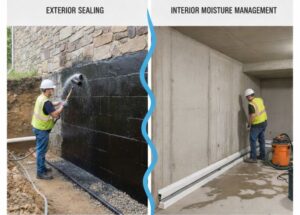
Typically, interior foundation waterproofing is a secondary measure, which is taken when water comes in through the cracks or joints and can be handled from the inside of the structure. These solutions basically control the water that is getting to the foundation wall.
Local repair of the damaged areas may consist of sealing the cracks, installing drainage channels, or setting up moisture redirection systems. Such solutions are usually referred to as a local repair of the damaged areas when the outdoor excavation is limited or is not required.
Generally, the term “interior work” is used in connection with basement waterproofing methods, especially when talking about water infiltration through foundation walls or floor joints.
When is exterior waterproofing considered?
Outdoor options deal with the water that is still coming from the roof or down the gutter and has not yet reached the foundation wall. Exterior foundation waterproofing usually means taking off the outer part of the foundation to put on protective barriers or drainage troughs.
A place where this method is used may be indicated by a situation in which there is a continuous pressure of water on the foundation or when cracks on the outside of the wall are found. Although exterior methods can be a little bit more complicated, they basically eliminate the problem by going to the source of the water instead of controlling it after its entry.
Since digging is necessary, exterior work is generally only advised after a thorough examination.
How do foundation cracks affect the waterproofing decisions?
One of the main ways that water may get into a building is through foundation cracks. The features of a crack, such as its size, direction, and activity level, are instrumental in determining the most suitable crack foundation repair method for long-term protection and stability.
There are inevitable cracks that can be closed off inside the building, whereas some will have to be accessed from outside. The choices for waterproofing go hand in hand with the plans for fixing the cracks, thus making sure that the ways of sealing correspond with the route that the water takes in the construction.
Such an integrated plan is an excellent step towards performance for a long time rather than a temporary moisture control.
What role does foundation type play in waterproofing?
Different foundation materials, like poured concrete or masonry, have varying interactions with moisture. The waterproofing methods are chosen based on how the materials behave.
For Example, moisture can pass through mortar joints of a masonry foundation, whereas a poured concrete foundation usually exhibits water intrusion at cracks or penetrations. Understanding these differences is essential when waterproofing a house foundation effectively.
By being specific about the materials, it is possible to refrain from using methods that may not be suitable for the structure.
Are there “best” solutions for every home?
Homeowners often ask about the best foundation waterproofing solutions, but the answer depends on site conditions rather than a universal standard.
One home’s effective solution may not be right for another because of differences in the land slope, soil, or the design of the foundation. That is the reason a professional inspection is very important to decide on the feasible options.
At Tru Integrity LLC, we make our recommendations accompanied by the reasons so that the clients can grasp the necessity of a particular method.
When do Interior and Exterior Methods Cooperate to Work Together?
There are instances where a mixture of inside and outside methods can be utilized. For instance, an exterior sealing can be the solution to central water pressure, whereas the inside measures take care of the remaining moisture.
It is not always required to have this layered approach, but it can be powerful in the case of complicated or long-standing water problems. The intention is to balance, just the foundation that is needed.
Halfway through the work, Tru Integrity LLC is committed to matching the repair methods to the real water route rather than making the unnecessary application of treatments.
How to know the Condition of Your Home?
Homeowners are usually expected to have a lengthy visual inspection of the property and an evaluation of moisture in wall cracks or similar places. These data provide very useful information to the experts about how the water is penetrating the walls or whether these moisture patterns can be caused by weather conditions, for example, by rain or snow, if the intrusion is active or seasonal.
On this stage, it is less of a guessing game and more of figuring out what kind of fixes are needed based on the evidence that the waterproofing issues have been noticed at the properties.
Have a Professional Foundation Waterproofing Assessment
If you have to deal with the problem of foundation cracks or recurring moisture, and need guidance that is based on the real situations, not on assumptions.
Tru Integrity LLC is the company that will provide you with inspection-driven recommendations fitted to your home.
Eventually, waterproofing will be effective only if it is based on a thorough understanding of how water is getting to your foundation.
FAQs
1.Are interior waterproofing methods always enough?
Not always; effectiveness depends on where water is entering the foundation.
2.Does exterior waterproofing require excavation?
Yes, exterior methods generally involve accessing the outside foundation wall.
3.Can foundation cracks cause ongoing water issues?
Yes, cracks often serve as direct entry points for moisture.
4.Are basement waterproofing methods the same for every home?
No, they vary based on structure, materials, and water sources.
5.Is waterproofing recommended even if leaks are minor?
Minor leaks can indicate underlying issues worth evaluating early.